Showing posts with label Carlos Robles-Martinez | Debt Restructuring Project. Show all posts

Monday, August 10, 2015

Finishing Reflections

Carlos Robles

My last entry will be a reflection of the progression of the project in the two countries I worked in over the last three months.

Mexico
I started by working two weeks in Mexico City. These first two weeks were a bit of a slow start since I was getting used to the city and trying to find a place to work, as well as develop a work plan that would allow me to complete the research objective.  I could not find any contacts to interview during this time in Mexico City, but I was able to find some valuable information regarding the changes in the Mexican bankruptcy law after 2000 as well as a lot of background information on bankruptcy practices.  After the first two weeks flew by, I headed to Argentina for nine weeks hoping to be able to interview local experts about these processes.

Argentina
I had never been to Buenos Aires before, so I was really looking forward for the opportunity to get to know the city and learn as much as possible about its history, as well as the research objective. My favorite part of the project was the high level of independence I had, because it allowed me to work from different coffee shops around the city and get to see and experience the many things that this beautiful place had to offer while working toward the project.

My host was the Universidad Astral IAE Business School in the outskirts of the Buenos Aires. Similar to my time in Mexico City, my first week and a half in Buenos Aires included learning a lot about how to get around and where to go to get some work done.  Once I was able to get in touch with the people at IAE, I was able to set up a schedule that allowed me to work more diligently on the project. They gave me my own work space in the area where the PhD students worked, and I was able to meet some people that way, as well as ask for their insights on any questions I had.  Everyone was extremely welcoming and accommodating, and I felt really comfortable there. 


Universidad Astral IAE Business School Campus in Buenos Aires
Another view of the IAE Campus
Once I was more acclimated to the city and my schedule, I was able to enjoy weekends to do various cultural activities, such as museum visits, explore local restaurants, go to concerts, and (my favorite) weekly Tango lessons at a local coffee shop. 
To say I enjoyed my time in Buenos Aires would be a huge understatement. I think being by myself in such a beautiful, yet calm city, coupled with all I learned along in the project really helped me feel like I grew a lot both professionally and personally. 

Around my fourth week in town, I made a really valuable connection with a prominent law firm in the city. My interactions with two of the lawyers from this firm created a lot of opportunities to meet important contacts that provided incredibly useful information about the restructuring practices of the companies we were interested in.  Through that connection, I was able to interview the former CEO of Fargo, which is one of Argentina’s most important food companies, but was eventually bought out by Mexico’s Bimbo.  Also through that connection, I was able to attend a Boca Juniors game. This was especially great because those games are actually closed off to members only, and tourists often have to pay 150 USD and up for a “tour” and game package, and I didn’t want to do that.  But, since I developed a good relationship with the lawyers at the firm, they let me borrow their box seats for one of the games!

Watching the Boca Juniors games in Buenos Aires
On top of the interactions with people, the process of getting information about the project from different contacts was thrilling; I had very few connections, so every time I talked to someone I was eager to ask them to further introduce me to people knowledgeable on the topic.  Thanks to that, I was able to set up interviews with former CEO’s, Professors, and lawyers who were directly involved in these processes, and who worked with the companies we were interested in learning about.
Back in Mexico
After being in Argentina for nine weeks, I had a week left to work in Mexico City, and luckily I was able to make a connection with a professor in Buenos Aires my last week there who put me in touch with two of Mexico’s most knowledgeable lawyers and professors in the topic of Mexican bankruptcy and debt restructuring practices.  With a lot more knowledge about bankruptcy proceedings and a better understanding of the history of the impact of economic crises in Latin America, my conversations with these two gentlemen really left me wishing I could have spent more time researching bankruptcy practices in Mexico. I say that because, on paper, Mexico has a very good bankruptcy law, but on practice, it falls short of being effective due to the high levels of corruption and ignorance of the proceedings in court.

Reflecting back on my experiences, I am really thankful for the way both countries welcomed me. I already miss the amazing steaks and wine I had in Argentina and also going to Tango classes on Sunday evenings.  Mexico also left me with a great sense of nostalgia, especially after being away for so long.

My experiences in both countries helped me realize I want to pursue a career that allows me to travel and work on projects in Latin America, and they also allowed me to realize how adaptable I can be and that I can thrive in very different environments.  Because of that, I am extremely happy I was able to be a WDI Fellow this summer and I look forward to this upcoming year and to what will come after graduation.


Saturday, August 8, 2015

Some Findings About Debt Restructuring Practices in Argentina

Carlos Robles

As I mentioned in the last post, the next entries will be focused on the research I did in Argentina and Mexico City. I will talk a bit about the progression of the investigation, challenges, and reactions about being abroad.

The research project focused on the strategies used by multinational Mexican and Argentine firms that filed for bankruptcy and whether they used their local bankruptcy laws, or the United States’ Chapter 11 to restructure their debt.  Before starting, I did not have a lot of background experience on this topic, but I was thrilled for the opportunity to learn more about it.
Now a bit on what I found.  Argentina faced its biggest economic crisis in 2001 and, long story short, one of the biggest problems was that the Argentine peso and the U.S. Dollar were valued on a 1:1 ratio, and when the true convertibility kicked in after the 2000’s, anyone who had debts in USD now had their debts almost quadrupled. Among other factors in the crisis, this was a very severe blow to the private sector. Because of that, there were a lot of companies falling under financial distress. But at the time, proceedings to restructure debt or file for bankruptcy were simply not very efficient. To change that, the government reformed the law in 2002 to expedite those processes. The change would be the equivalent to a Pre-Packed Chapter 11 in the United States, where the debtor and the creditors come to an extrajudicial agreement and then present it to the judge to approve the new payment plans. This made the process a lot faster and more seamless. Due to this change, most companies opted to use that process instead of seeking protection under Chapter 11 in the United States, even if they did have some assets abroad.
The most interesting finding, in my opinion, was the fact that there were indeed some Argentine companies that were involved with Chapter 11 in some capacity, five of the biggest companies in the country, actually. But what was interesting was that the U.S. creditors wanted to bring them to the United States to file for bankruptcy instead of letting them do it in Argentina.  However, these companies’ best interest were served in Argentina’s courts, so they had to show the New York District Court Judge that Argentina had bankruptcy proceeding similar to those in the United States. This was all due in part to the change in the law of 2002. Since that change in the law, a lot of Argentine companies were able to successfully restructure their debts and continue operating.

Friday, July 17, 2015

Debt Restructuring in Mexico and Argentina - and Some Background to My Internship ....

Carlos Robles-Martinez

I have been abroad for nine weeks, two weeks in Mexico City and now I’m completing my seventh week in Buenos Aires. If you know me, and don’t know many details about the trip, you’re probably wondering, “Carlos, I thought you weren’t allowed to leave the country? What changed?”  And if you don’t know me, you’re probably wondering why anyone would ask that question.  All are fair questions.  Because of that, one of the goals of this blog is to reflect on my experiences and the research I am doing through the William Davidson Institute, and how that project allowed me to go back to my home country, Mexico, after such a long time away, and also travel to Argentina, a country I had always wanted to visit. Another goal is to shed some light on the latest immigration policies that allowed me to leave the U.S., and where they stand today.
Let’s start with a description of the trip’s purpose. As part of the Master’s in Public Policy at the Ford School, we are to complete a policy related internship or project. To that end, I applied to one of the William Davidson Institute’s fellowships.  My project is to research debt restructuring strategies used by Mexican and Argentinian multinational firms that borrowed the United States Chapter 11 law to restructure their debt after they fell under financial distress. I will talk more about the project and the findings themselves in a later blog entry.

With that in mind, I can now answer the question of how I was able to leave, and why that is a relevant question. This question is relevant because I was an undocumented immigrant. Back in 2010, my brother and I were arrested and put in a county jail for three days for having over-stayed our visas and not having documentation on us while traveling by train through New York.  We were then in risk of deportation.  After a long process, and with the help of the National Immigrant Justice Center in Chicago, we were allowed to stay in the country through Deferred Action for Childhood Arrivals (DACA).  DACA is President Obama’s 2012 executive order to grant deportation relief and work authorization to undocumented immigrants who meet several requirements

Now, a quick clarification, I said up there that I was an undocumented immigrant. Technically, that’s true, because now I do have legal documents issued by the United States.  This puts me in a much more comfortable and safe situation than before, but DACA has many nuances. It does not let me apply for citizenship, it simply protects me from being deported, and it lets me work and live in the United States.  With it, I can keep paying income taxes, as I did before having DACA, and I am given a social security card in order to get a driver’s license, but I cannot to collect social security or receive any federal funds - like FAFSA.  This form of relief also does not allow me to leave the country for pleasure.  However, if given employment, educational, or humanitarian opportunities outside of the United States, I can apply for what the United States Citizenship and Immigration Services (USCIS) calls Advance Parole, to take advantage of that opportunity and not be penalized.  If I left the country for any other reason, I would not be able to return. Since my current research project is going towards completing a master’s degree, USCIS granted my Advance Parole, and I find myself writing this blog entry from a coffee shop in Buenos Aires while listening to some live Tango music. It had been eleven years since I had been outside of the United States.
Café Borges and a live Tango
Being in Argentina is by far one of the best things I have experienced, but the highlight of this trip was being back in Mexico after such a long time away. When I was fourteen and brand new to the US, I really wanted to go back home and would think about it incessantly. But after the realities of our situation settled in, I made peace with the fact that such a trip was very unlikely in any near future.  Eleven years later, I realized I had the opportunity to apply for a project that would allow me to return; I did so with caution, knowing that there was the possibility of getting Advance Parole denied.  It took about two months to get an approval, and even when I received the notice it was still hard to make sense of the feelings. I knew it meant I could finally go back, but it had been a long time since I had thought about that. I was excited to return, but I had no clue what to expect.

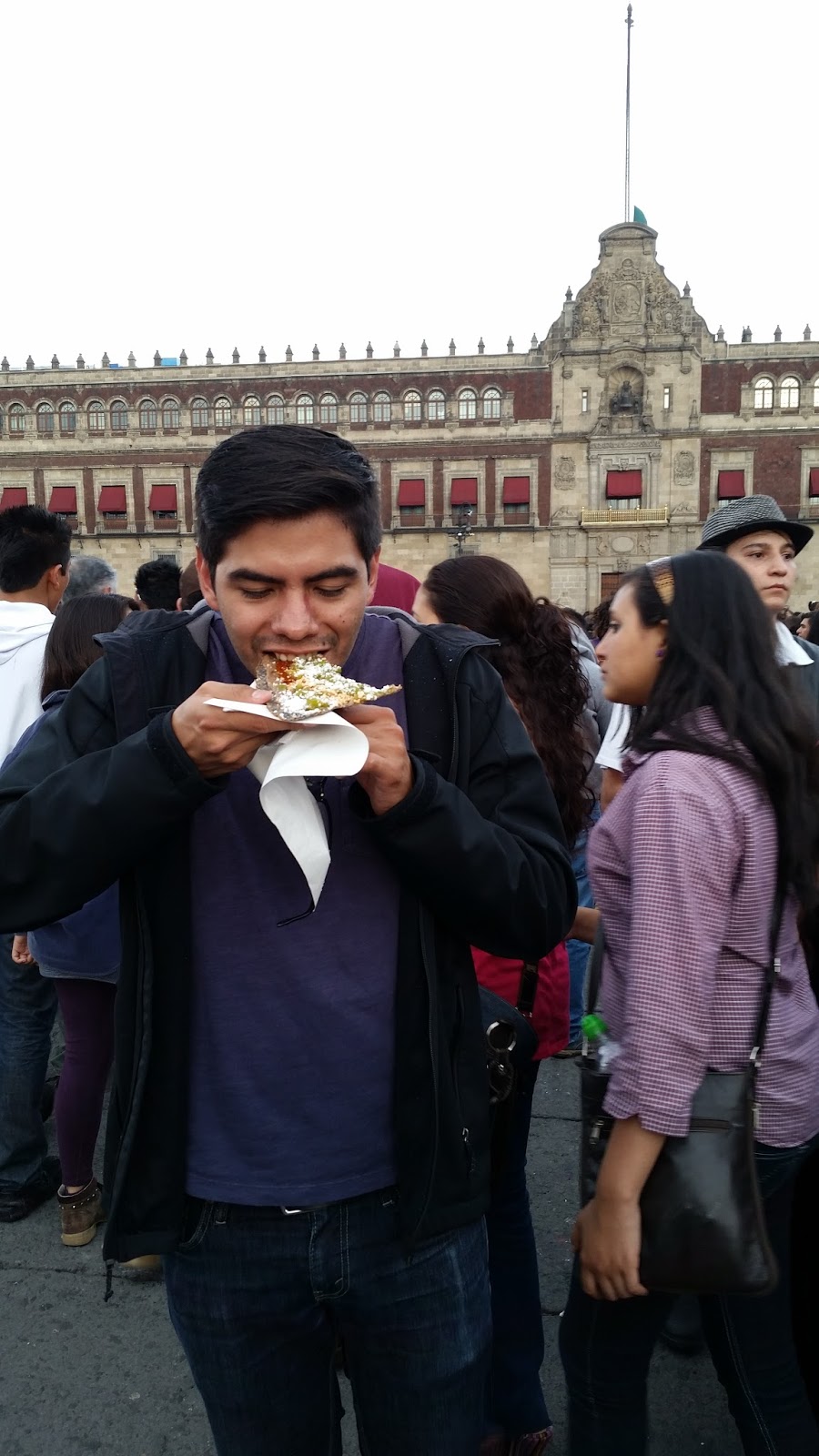
To keep this from getting too long, let’s fast forward to my arrival in Mexico. The first thing I noticed once there was that Mexico City is a mess!  One beautiful, beautiful mess, that although may deserve some of the bad reputation it has, does not nearly get enough credit for all the positive things it offers.  As one of the most populated cities in the world, anywhere you go, you will likely find a crowd of people.  Being there, I realized how much I missed being able to talk to everyone and ask for what I wanted just using my Spanish and not having to worry if they’d understand or not.  I missed making all the jokes I wanted with family I hadn’t seen in years.  And hearing everyone around me yelling things in Mexican Spanish, some hilarious, some gross, but all so refreshing.  One of the things I tried to do while in the U.S. was to maintain a full fluency of Spanish, which I think helped in making everything  feel so strangely familiar, even after all the years. I didn’t have to worry about anything getting lost in translation at all, and I could just focus on everything that was going on around me. Being able to walk down the street and really smell from some of the worst scents to some of the most delicious, mouthwatering ones that led you to a bakery, tacos, or a restaurant, all amazing.
Back in Mexico and eating everything within sight
I was also able to easily get used to their public transportation that, even though it is chaotic, takes you anywhere you need to be, and quickly. This level of comfort allowed me to fully enjoy this amazing city that somehow manages to maintain its roots while also being incredibly modern. There is such a rich history and so much to learn and see; from ancient ruins, to the Soumaya Museum; from street food, to some of the best restaurants in the world. I felt so fortunate to be there, and happier than I had been on a trip in a long time. While I was there, the only thing I was missing was my family, because they still have not had the chance to leave the U.S., and while they are happy for me, I know they wish they could have been there just as much as I had.
The Soumaya Museum in Mexico City
To begin closing, I don’t really want you to read this post and only take from it (aside from my love for Mexico City) that being undocumented in the United States is a really difficult experience, and have you try to relate to it. It undoubtedly is difficult. Instead, I’d rather bring your attention to the fact that there just is no real federal solution or way for “low-skilled” immigrants like my family, and their children to migrate to the U.S. legally. And when they do make it there illegally, and they lead productive and law abiding lives on after, there is no way for them to apply for a legal status, even after years of contributions to the country.  The closest we have come is DACA, which only applies to children of immigrants, but even that is at stake now.  Last February, a Texas judge issued an injunction before an expansion of the program was to take place. Two key features of the expansion were to get rid of the age cap for applicants, and also extend deportation relief to parents of U.S. born children. Since the injunction, millions of people still have to live their lives with extreme caution, tip-toeing their way to work and school every day.
With that shift in focus, I want you to be aware of what you can do. If you find yourself in a position where you can change policies or interact with people who are undocumented, please realize that you can help beyond only being aware of our issues. Institutions and employers alike need to know that the federal government often does not have institutional restrictions set at a national level. That means individual institutions can increase services for undocumented immigrants without federal permission or negative consequences. Some brief examples are: issuing private funds as scholarships, passing in-state tuition at universities, conducting professional development for human resources staff, or issuing healthcare and providing a fair wage to employees.  None of those are dictated by federal regulations, and have a huge impact on people’s lives.  And while there is no solution being put forth by the government, a change in our institutional practices can trigger a change in our mindsets, and ultimately lead to the change we have been working for.